A quiet ceremony beside a residential venue, a corporate launch inside a heritage building, and a festival main stage may all need temporary power. But they do not need the same power source. The decision on diesel versus battery generators affects more than sound levels and fuel use. It determines runtime, cable design, backup planning, access requirements and whether the show keeps moving when the site load changes.
For event power, the right answer is rarely based on a single specification sheet. It comes from understanding what is running, when it is running, how critical it is and what happens if it stops.
Diesel versus battery generators: the practical difference
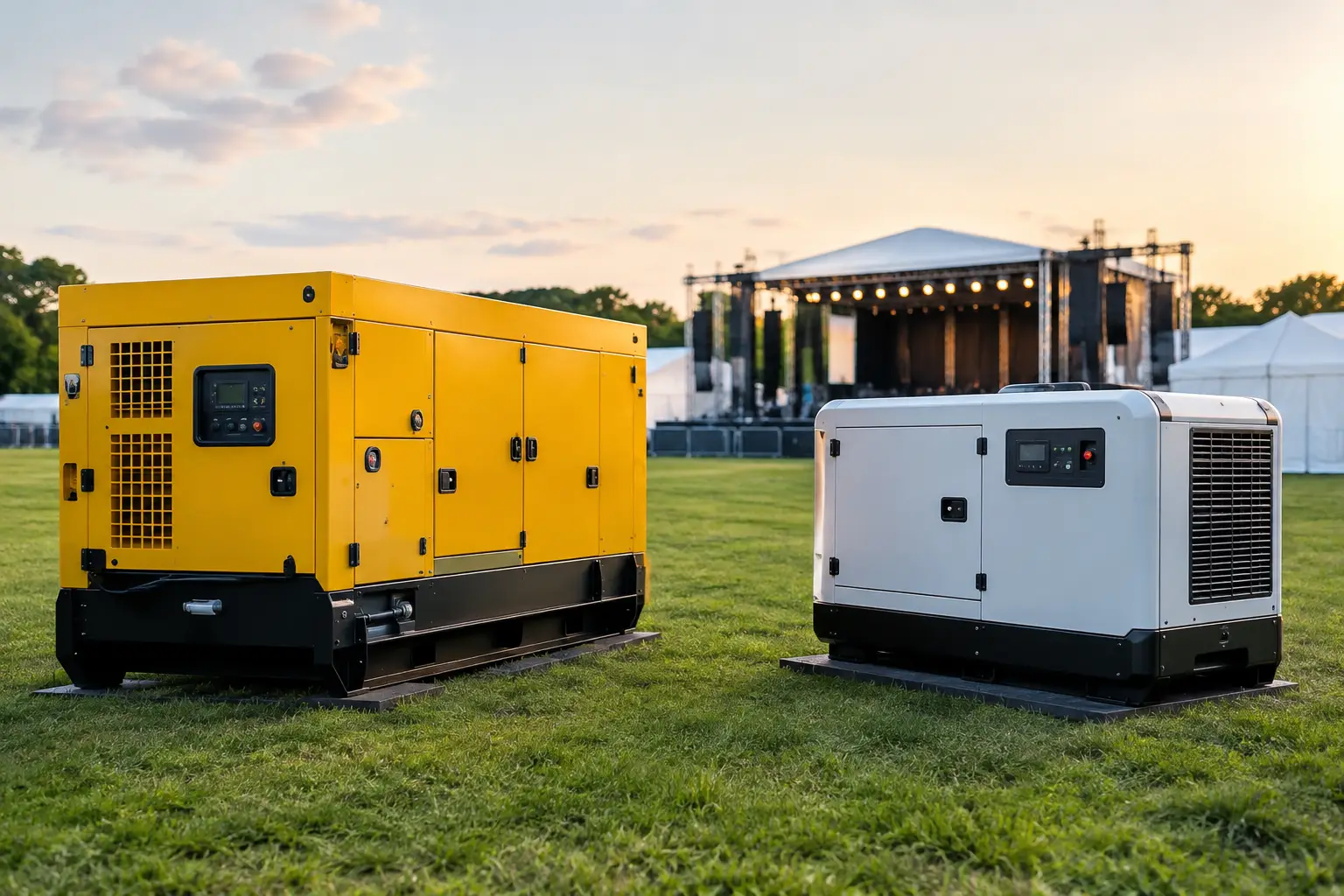
A diesel generator produces electricity continuously while it has fuel and is operating within its rated capacity. It remains the proven workhorse for large or long-running events, particularly where three-phase distribution, high peak loads or all-day runtime are required.
A battery generator stores electricity in a battery energy storage system, then supplies it through an inverter. It produces no exhaust emissions at the point of use and operates with very little noise. That makes it valuable where sound, fumes and access restrictions are part of the brief.
The key difference is energy availability. A diesel unit can be refuelled and continue operating. A battery system has a finite stored capacity and must be recharged from mains power, solar input or another generator. For a short, controlled load, that can be an excellent trade-off. For a 12-hour festival site with lighting, catering, audio, refrigeration and production offices all drawing power, it requires far more careful modelling.
Start with the event load, not the equipment
The most expensive power mistake is selecting a generator based on the wattage printed on a few appliances. Events do not behave like a steady household load. Audio systems have peaks. Refrigeration compressors cycle. LED walls, moving lights and catering equipment can create significant changes in demand. Motors and some power supplies also draw a higher start-up current than their normal operating load.
A proper power plan identifies the connected load, expected running load and peak demand across each event phase. Build days, rehearsals, doors open, show time and pack-down can all look different. It also separates essential circuits from loads that can be shed without stopping the event.
For a wedding, a battery system may comfortably cover ceremony audio, feature lighting and a small bar area for a defined period. Add electric catering, cool rooms, portable air-conditioning and a full band package, and the calculation changes quickly. For a public event, the system must also account for distribution boards, cable runs, protection devices, weather exposure and safe public separation.
This is why experienced event crews ask detailed questions before recommending a unit. Generator size is not a guess, and bigger is not automatically safer. An oversized diesel generator operating at a very low load can be inefficient and may create operational issues of its own.
Where diesel generators still lead
Diesel remains the practical choice when the event needs high output, long endurance and flexible refuelling. It is particularly well suited to outdoor festivals, sporting events, temporary venues and remote sites without reliable mains access.
A correctly sized diesel generator can support substantial three-phase loads and run across long production days with managed fuel plans. It also gives crews confidence where schedules extend, weather changes the operating conditions, or additional production equipment arrives late in the process.
Diesel has other operational advantages. Units are familiar to technicians, readily integrated into event distribution systems and available across a wide range of capacities. With acoustic treatment, sensible placement, cable management and correct exhaust direction, generator noise can be controlled effectively for many event environments.
The trade-offs are real. Diesel generators need a suitable external location, safe fuel management, clearance for exhaust, delivery access and a plan for noise. They cannot be placed inside occupied rooms or close to air intakes, and they may be unsuitable near sensitive neighbours, quiet ceremony spaces or indoor activations. They also require active monitoring, not a drop-off and hope approach.
Where battery generators make sense
Battery generators are at their best when the load is modest, quiet operation matters and the running window is known. Think registration desks, small outdoor ceremonies, brand activations, green rooms, exhibition stands, low-power lighting or overnight loads that would otherwise keep a diesel generator idling.
Their lack of local exhaust emissions can open options in enclosed or noise-sensitive environments, subject to venue approval and electrical requirements. They are also well suited to locations where a generator truck cannot be positioned close to the event area, or where running long leads from a distant generator would compromise the presentation.
For an event organiser, the visible benefit is simple: less noise around guests and less equipment competing with the look of the event. For the production team, the benefit is more controlled power for suitable loads. That does not mean battery power is maintenance-free or unlimited. The stored energy must be matched to the real consumption, with headroom for peaks and a clear recharge or changeover plan.
Battery systems can also have limits around high inrush equipment, large three-phase loads and extended runtime. A quiet battery unit that runs flat halfway through speeches is not a sustainable solution. Runtime claims only mean something when the actual load is known.
The hybrid option is often the smarter option
Many events do not need to choose one technology for every circuit. A hybrid power plan can use batteries for low-load or noise-sensitive periods, then use diesel generation when demand rises. It can also use a battery system to smooth fluctuating loads, reducing the time a diesel generator spends operating inefficiently at low demand.
For example, a site may run registration, site lighting and production offices from battery storage during bump-in, then bring the main diesel generator online for show lighting, catering and headline entertainment. After the audience leaves, batteries can keep security lighting, refrigeration and essential overnight systems running quietly.
This approach is not automatically cheaper. It involves more planning and, in some cases, more equipment. However, it can reduce noise during critical guest-facing periods, improve fuel efficiency and give the event team a more refined operating plan. The value comes from matching the source to the load, not from using battery technology for its own sake.
Questions that decide the right event power plan
Before choosing between diesel, battery or hybrid power, the production brief needs clear answers to a few operational questions:
- What equipment will run simultaneously, and what are its starting and peak demands?
- How many hours must each circuit operate without interruption?
- Does the site require single-phase or three-phase supply, and where will distribution boards sit?
- Are there noise limits, indoor locations, neighbouring residences or emission restrictions to manage?
- What is the backup plan if a generator faults, fuel delivery is delayed or a battery reaches its reserve level?
These questions shape the equipment selection, but they also shape the crew plan. A generator without monitored distribution, tested cables, weather protection and someone accountable for the system is only part of the job.
Reliability comes from the full system
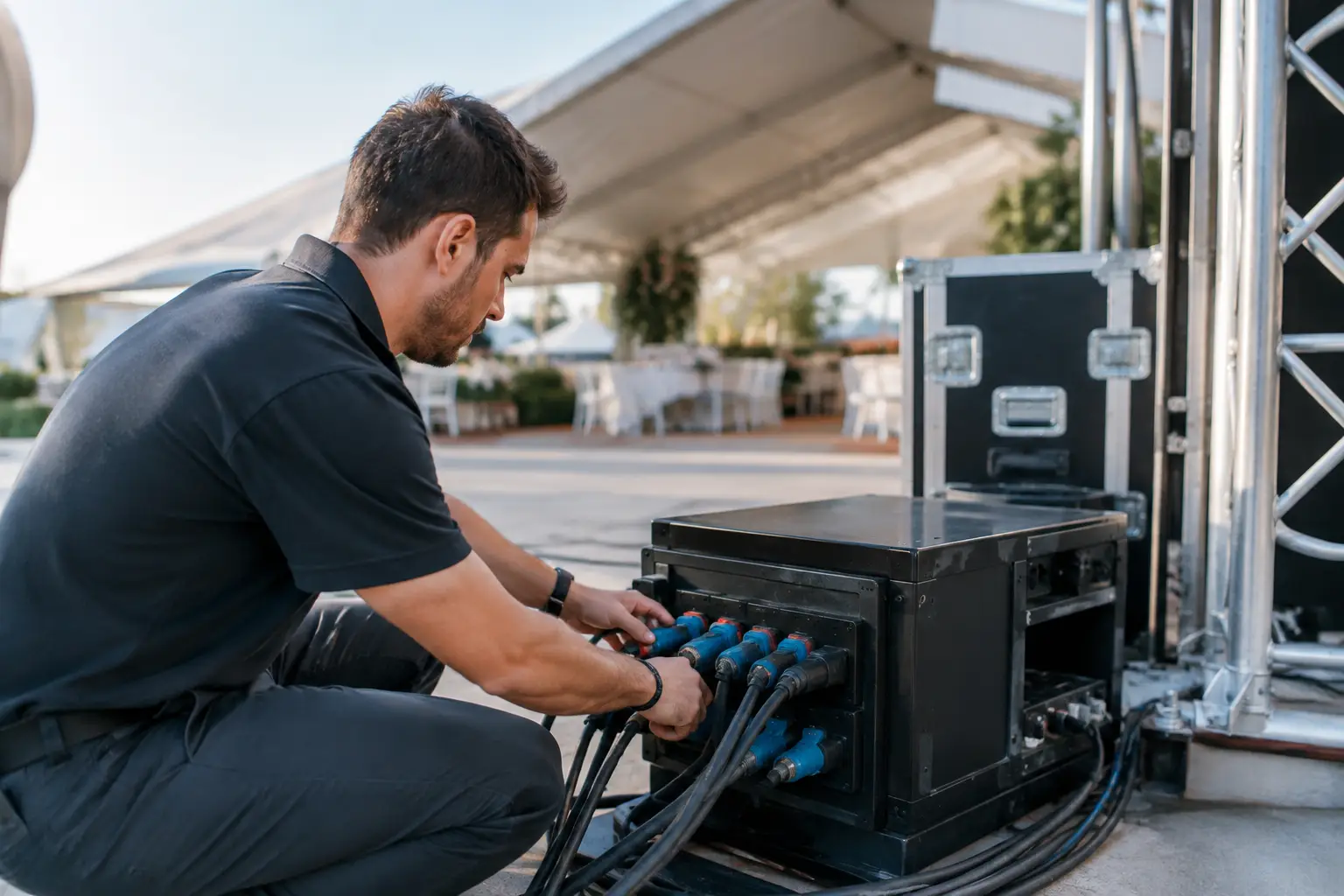
Event power is a chain. Generator capacity matters, but so do the switchboards, cable routes, RCD protection, earthing arrangements, fuel procedures, load balancing and contingency equipment. A sound system can be technically excellent and still fail if it shares an overloaded circuit with catering. A battery system can be well sized and still disappoint if its recharge window was never protected in the run sheet.
For larger events, critical systems should be identified early. Emergency lighting, essential communications, medical areas, production control and headline-stage audio may require separate distribution or backup arrangements. The level of redundancy depends on the consequence of failure. A brief interruption at a small garden party is one thing. Losing a main stage during a ticketed event is another.
In Melbourne, venue constraints can add another layer. Laneway access, heritage conditions, apartment neighbours, restricted loading zones and wet-weather contingency all influence where power equipment can sit and how it will be managed. That is why the best power plans are developed alongside staging, AV, lighting and site logistics, not after everything else has been locked in.
A good event power solution should disappear into the background. Guests hear the vows, not the generator. The stage stays live until the last note drops. And when the schedule changes, there is a crew on site who knows exactly what to do.