A generator that looks right on paper can still fail when the band starts, the caterer fires up the ovens and site lighting comes on at dusk. That is why knowing how to calculate event power load is not a box-ticking exercise. It is the difference between a controlled event site and a very public power problem.
For a wedding reception, corporate launch or school fete, the numbers may be straightforward. For a festival, sporting event or public activation, power planning becomes a live operational system involving generators, distribution, cable routes, phase balancing, backup and qualified crews. Start with a sound calculation, then allow for the conditions that do not appear in a supplier’s brochure.
Start with a complete equipment schedule
Power load calculations begin with a proper equipment schedule, not a guess based on guest numbers or generator size. List every item that will draw power, where it will be located, when it will run and whether it has a high start-up demand.
That includes the obvious equipment: PA systems, mixing consoles, stage lighting, LED screens, projectors, DJ gear, fridges and catering equipment. It also includes site essentials that are easy to miss, such as marquees with lighting, ticket scanners, EFTPOS, Wi-Fi, production offices, radio chargers, toilets, pumps, security lighting, cleaning equipment and vendor power.
Ask each supplier for the equipment’s rated input power in watts, kilowatts or amps. Do not rely on a verbal estimate of what their setup ‘usually uses’. A coffee cart, for example, may have a modest frontage but can carry several high-draw appliances. An LED wall may use considerably less than older display technology at normal brightness, yet its power supply, processors and associated AV equipment must still be counted.
For each item, record its rated load and its operating pattern. Is it on continuously? Does it cycle on and off? Will it start under load? Is it single-phase or three-phase? Those details shape the final generator and distribution design.
How to calculate event power load in kilowatts
The basic calculation is simple:
Total connected load (kW) = total equipment watts ÷ 1,000
If an item is listed in amps rather than watts, use:
Single-phase watts = volts × amps
At Australia’s nominal 230 V single-phase supply, a 10 A appliance can draw up to 2,300 W, or 2.3 kW. A 15 A appliance can draw up to 3.45 kW. These are maximum figures, not necessarily the appliance’s normal running draw, which is why manufacturer data is always preferable.
For three-phase equipment, calculations are more involved because voltage, current and power factor all matter. A practical event plan should use the manufacturer’s stated kW or kVA requirement and be reviewed by a qualified electrician or production power specialist. Never select a generator solely by adding a few amp ratings across three phases.
Here is a simple example for a small outdoor function:
| Equipment | Rated load | Estimated demand | | — | —: | —: | | PA, DJ and control | 3.0 kW | 3.0 kW | | Stage and ambient lighting | 4.0 kW | 3.5 kW | | Catering refrigeration | 2.0 kW | 1.5 kW | | Coffee machine and hot-water unit | 5.0 kW | 5.0 kW | | Marquee, site and security lighting | 2.0 kW | 2.0 kW | | EFTPOS, charging and miscellaneous | 1.0 kW | 1.0 kW |
The connected load is 17 kW. The estimated operating demand is 16 kW. That does not mean a 16 kW generator is the answer. The next steps are where event power plans either hold up or fall apart.
Allow for demand, start-up current and headroom
Not every appliance runs at maximum load every second of the event. This is known as demand or diversity. Refrigeration cycles. Some lighting cues are not at full intensity continuously. A production office may be quiet for most of the day. Applying sensible diversity can prevent unnecessary generator oversizing.
But diversity is not permission to be optimistic. High-demand catering equipment, kettles, urns, heaters and coffee machines are often used at the same time, particularly during guest arrival and service periods. That peak is what matters. A caterer plugging in an extra appliance late in the day can trip a circuit or overload a generator that had no real margin.
Motors and compressors also need special attention. Refrigeration, pumps and some mechanical equipment can draw a substantially higher current while starting than during normal operation. Audio amplifiers and modern switch-mode power supplies can create challenging peak and harmonic loads too. A generator that is technically large enough may still deliver poor voltage stability if it is poorly matched to the load profile.
As a working planning principle, allow a meaningful capacity margin above your expected maximum demand. Often that means around 20 to 30 per cent, but it depends on the equipment, the generator type, the availability of backup power and how certain the final equipment schedule is. More headroom may be appropriate where catering, motors, large AV systems or last-minute supplier additions are involved.
Convert kW to generator kVA carefully
Generators are commonly rated in kVA, while event equipment may be specified in kW. They are related, but they are not interchangeable.
kVA = kW ÷ power factor
Power factor reflects how efficiently equipment uses supplied electrical power. A generator may be rated at a power factor of 0.8, meaning a 100 kVA generator may provide roughly 80 kW of usable real power under that rating. Actual performance depends on the generator and the connected load, particularly with electronically controlled AV and lighting equipment.
Using the earlier example, a 16 kW estimated demand divided by a 0.8 power factor equals 20 kVA before any operating margin. Add a 25 per cent allowance and the requirement becomes 25 kVA. In reality, the selected unit may need to be larger again depending on phase distribution, starting loads, connector requirements and contingency planning.
This is why a neat calculation should be treated as the start of generator sizing, not the final decision. The right solution may be one generator, a larger three-phase unit, separated power supplies for catering and production, or a main generator with standby support.
Balance three-phase power across the site
On larger event sites, a three-phase generator is usually used to supply multiple distribution boards and circuits. The total load can look acceptable while one phase is overloaded and the other two are lightly loaded. That imbalance can cause nuisance trips, voltage issues and poor generator performance.
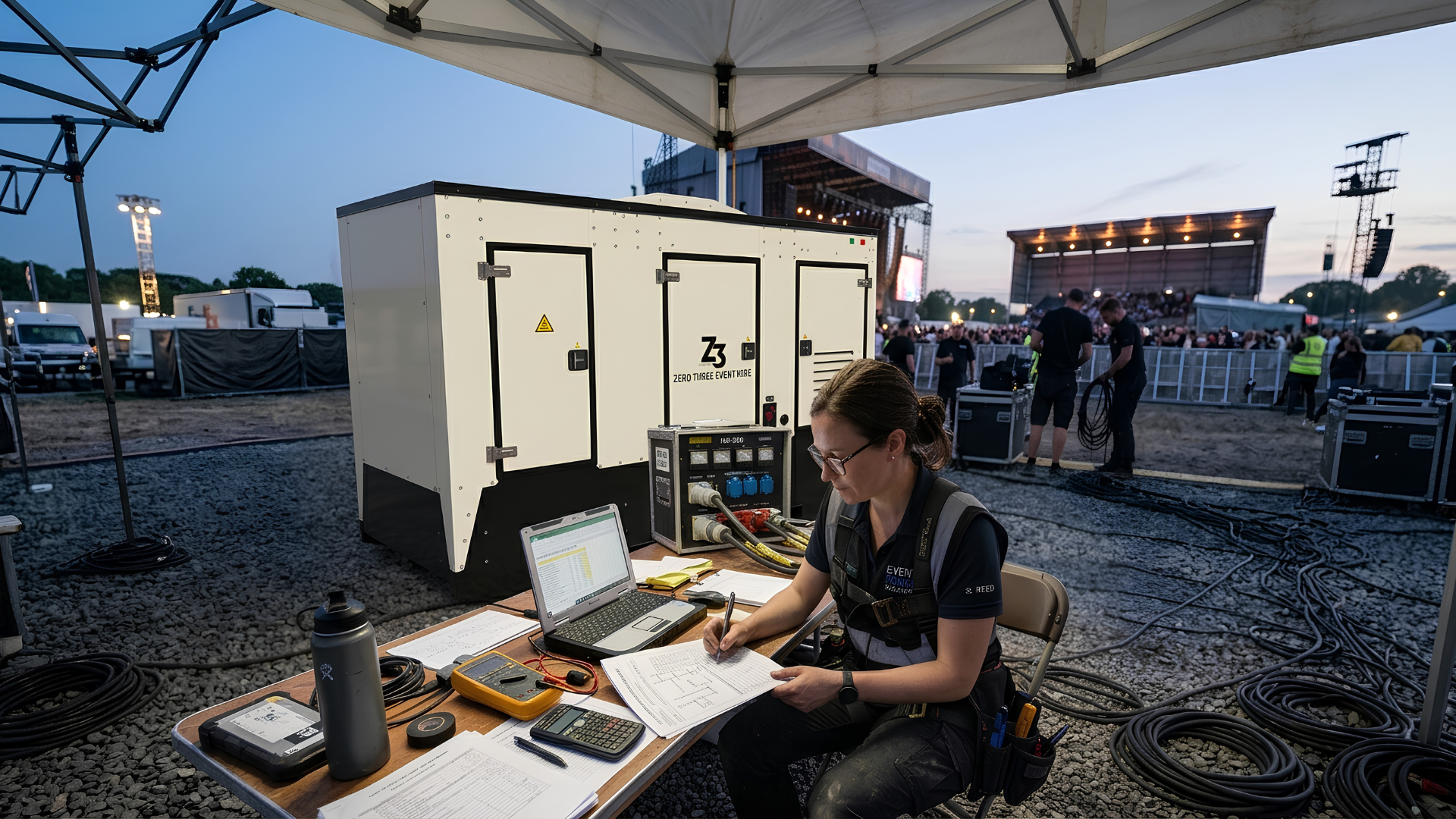
A proper distribution plan assigns single-phase circuits across the three phases as evenly as possible. The production team needs to know which loads belong on which outlet, especially where catering, bars, AV and vendor areas are added by different suppliers. Labelling circuits and keeping a current power schedule on site prevents a lot of avoidable confusion.
Do not treat power distribution as an extension lead problem. Cable sizing, protection devices, weather protection, cable ramps, isolation, earthing arrangements and RCD protection must be suitable for the installation. Temporary event electrical work should be designed, installed and tested by appropriately qualified people, with the required compliance documentation for the venue, council or event authority.
Plan for the event timeline, not just the room layout
The highest load is often not during the headline performance. It can be during bump-in, when tools, work lights, AV testing, catering preparation and site services operate at once. It can occur at doors open, when bar refrigeration, kitchen equipment, lighting and entertainment all ramp up. It can also occur during pack-down if suppliers share a reduced power supply.
Map the load against the full event schedule. Identify what must stay live during changeovers, what can be switched off, and what is genuinely critical. Emergency lighting, medical facilities, communications, security systems, ticketing and essential refrigeration may need priority supply or backup arrangements. A festival with multiple stages may also need separate generation zones so a fault in one area does not silence the whole site.
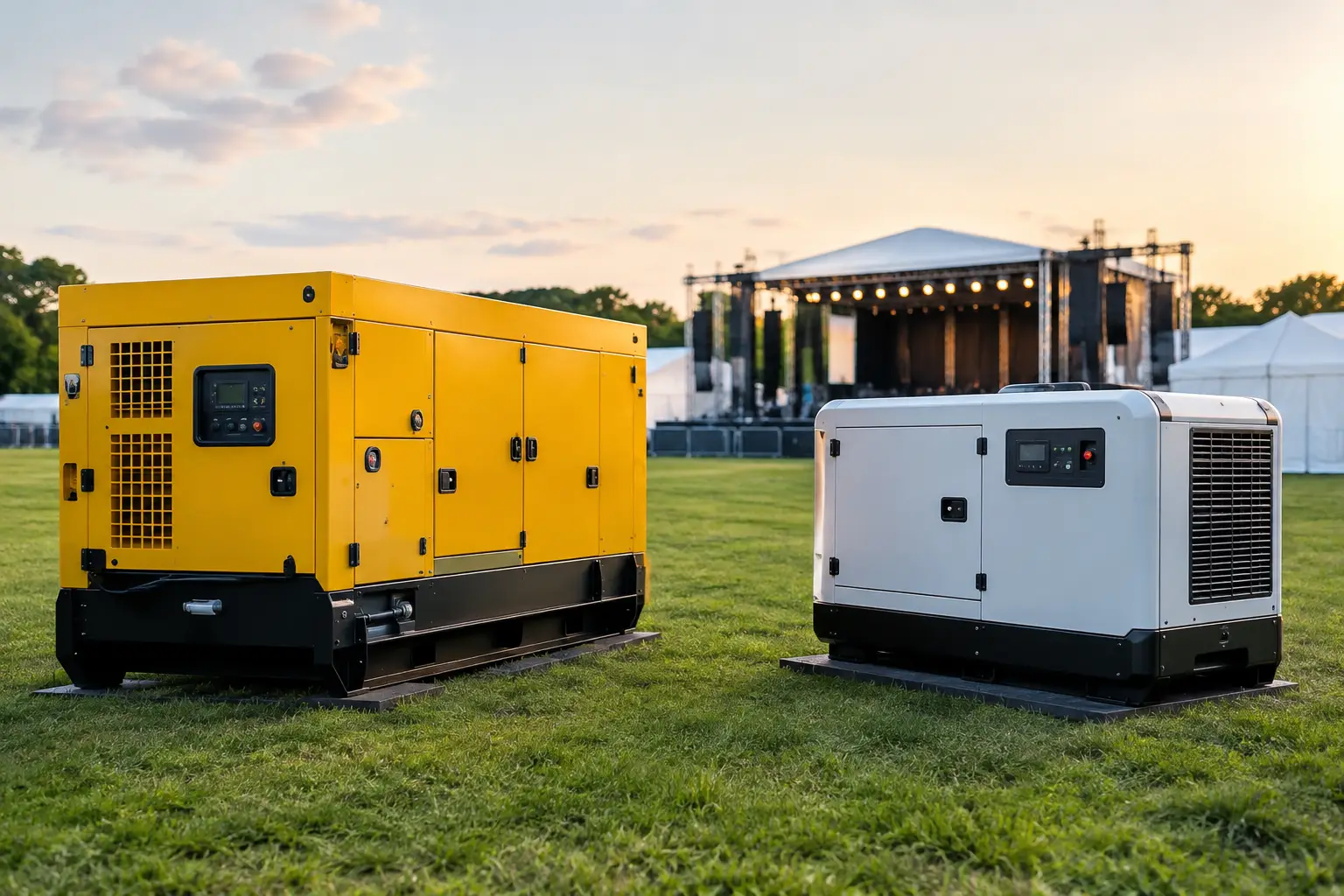
Fuel is part of the calculation too. Generator run time changes with load, and overnight operations, remote sites and long event days need a fuel plan with safe refuelling procedures. Quiet generators may be essential near accommodation or ceremonies, while generator placement must also consider exhaust, access, noise, weather and cable distance.
Build contingency into the brief
The cheapest power quote is rarely the lowest operational risk. If your event cannot tolerate an outage, specify the consequence of failure early. A keynote address may need isolated clean power for presentation systems. A wedding may need a backup path for the ceremony PA and lighting. A public event may require redundancy for safety-critical systems.
At Zero Three Event Hire, power scoping is handled alongside staging, AV, lighting, structures and on-site crew requirements, so the generator is selected for the actual event rather than hired as an isolated item. The aim is clear accountability from the first load schedule through to final pack-down.
Bring your suppliers, site plan and running order into the same conversation before equipment is booked. A power load calculation is most valuable when it becomes a managed site plan – one that gives every circuit a purpose, every critical system a margin, and your event team the confidence to focus on the moment in front of the audience.