A stage choice can determine whether bump-in runs to plan or starts with a crew trying to solve an access problem at 6 am. In the temporary staging versus truck stage decision, the best option is not always the fastest-looking one. It is the structure that fits your site, audience, show requirements, compliance obligations and production schedule without creating compromises later.
For a small corporate presentation, school performance or wedding band, a truck stage may be a smart, contained solution. For a festival, public activation, church production or tailored venue layout, temporary modular staging can provide far more control. The right answer comes from scoping the entire event infrastructure – not choosing a stage in isolation.
Temporary staging versus truck stage: the practical difference
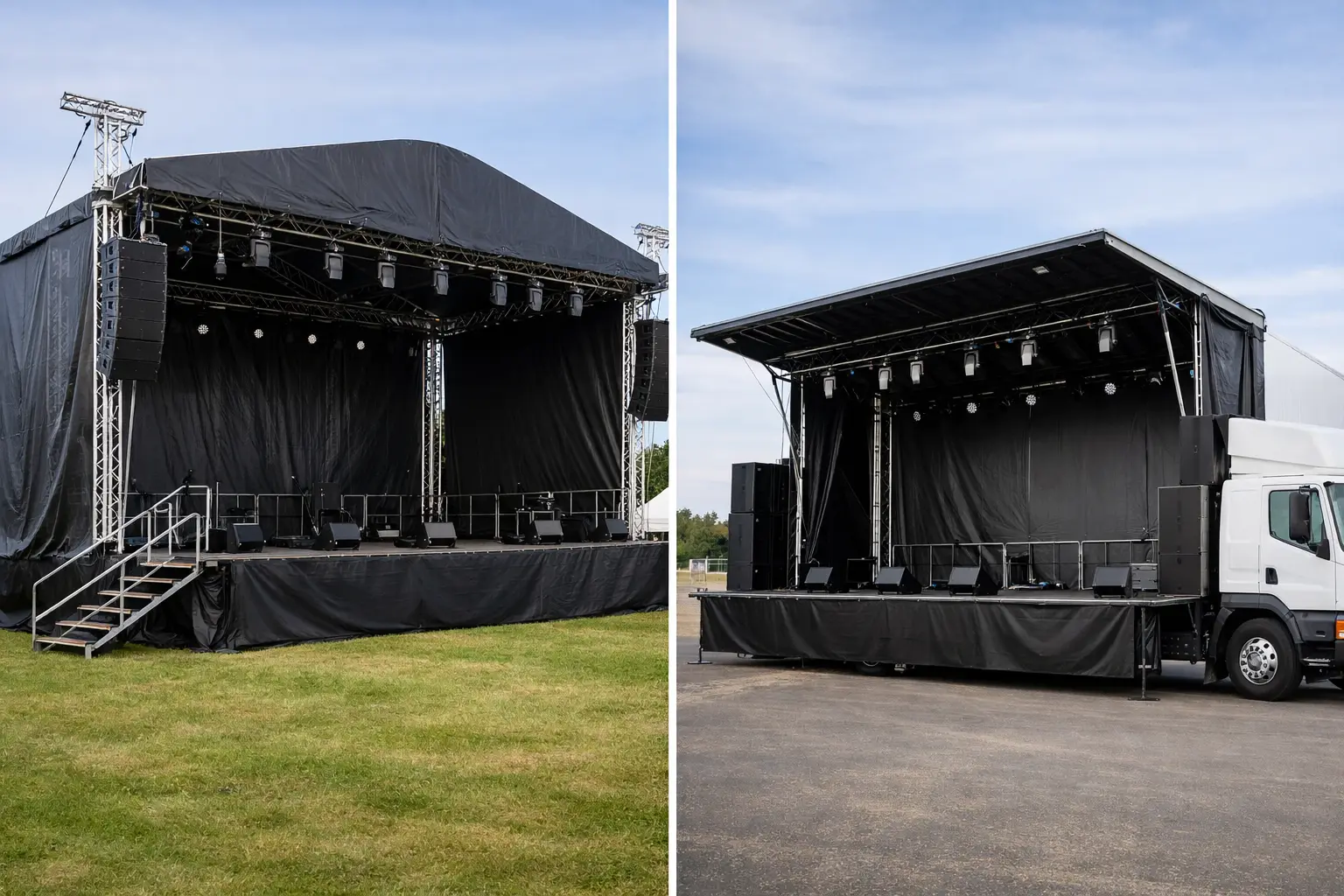
A truck stage is a self-contained mobile stage built onto a trailer or vehicle platform. It arrives largely assembled, then unfolds or hydraulically raises into its working position. The roof, deck and some rigging points are integrated into the unit, making it a practical option for outdoor events with straightforward stage requirements.
Temporary staging is built from modular decks, legs, stairs, handrails and structural components on site. It can be configured to a chosen width, depth and height, then integrated with ramps, roof systems, ground support, screens, PA towers, lighting and backstage areas. It takes more planning and labour to build, but it is designed around the event rather than asking the event to fit the trailer.
Neither is automatically better. A truck stage brings speed and simplicity where access is clear and the standard format works. Temporary staging brings flexibility where the venue, programme or technical design is less standard.
When a truck stage makes sense
Truck stages are particularly useful when time on site is tight and the performance format is uncomplicated. A community event in a park, a local sporting presentation, a council activation or a daytime music programme can benefit from the fast deployment of a pre-engineered mobile stage.
Because much of the structure is already integrated, the setup window can be shorter than a comparable custom build. That can reduce on-site labour and make the production schedule easier to manage, especially where venue access begins late or the event must return a public space quickly.
A truck stage can also create a neat operational package. The covered performance area, roof and basic rigging capacity are contained within one structure, which can be ideal for spoken-word programmes, modest bands, DJs and presentations. If your production only needs a straightforward PA, limited lighting and a clean front-of-house look, it may avoid overbuilding the job.
The trade-off is fixed geometry. Deck dimensions, trim height, roof load limits, access points and trailer footprint are largely predetermined. If your show needs a broad choir riser, a catwalk, a second performance zone, substantial LED screens or a larger line-array system, a standard truck stage can become restrictive quickly.
Where truck stages can create problems
The phrase ‘quick setup’ can hide a critical detail: the truck still has to get into position. Mobile stages need suitable vehicle access, manoeuvring room, stable ground and adequate clearance from trees, buildings, overhead services and site furniture. A tight laneway, sloping reserve, underground car park or inner-city venue may rule it out before the event starts.
Ground conditions matter too. The structure’s outriggers and support points require proper bearing capacity and level assessment. Wet grass, soft ground or a site with unknown underground services may need protection, engineering review or a different staging solution. It is not enough for a truck to physically reach the location.
Truck stages are also less forgiving where sightlines need to be deliberately shaped. A product launch may need the audience close to the presenter. A wedding band may need to sit neatly within a marquee floorplan. A festival may need a stage depth that accommodates backline, changeovers and crew movement. If the fixed deck does not suit the room, the whole event can feel compromised.
Why temporary staging earns its place
Temporary staging is the stronger choice when the stage needs to perform more than one job. It can be built to suit a venue’s dimensions, accommodate uneven or complex layouts, create different platform levels and provide safer access for performers, crew and equipment.
That flexibility matters when production elements begin to stack up. A polished event may require a stage, stairs, wheelchair access, handrails, roof structure, PA hangs, lighting truss, LED screens, backstage wings, cable pathways and crowd barriers. With a modular build, these components can be planned as one integrated system rather than added as last-minute attachments.
It is also often the better approach indoors. Ballrooms, warehouses, theatres, church halls and marquees commonly have loading constraints, door widths, low clearances or no practical route for a mobile stage. Modular decks can be brought in piece by piece and built precisely where they are needed.
For brand-sensitive events, temporary staging offers more presentation control. Stage fascias, black masking, carpet finishes, custom dimensions and carefully positioned stairs can make the difference between a hired platform and a professional show environment. For corporate audiences, weddings and public-facing activations, that visual discipline is part of the event experience.
The real comparison: speed versus control
It is tempting to frame temporary staging versus truck stage as a simple question of cost. In reality, the most useful comparison is speed versus control.
A truck stage can be faster to deploy where the site is suitable, the stage size fits and the production is modest. It may lower labour requirements and simplify the initial infrastructure plan. But adding external PA towers, large screens, ramps, crowd-control systems or extra decks can reduce that advantage.
Temporary staging takes a longer build window because the crew must construct, level and secure the platform on site. Yet it can prevent costly changes elsewhere. A correctly designed deck can remove the need for awkward sightline workarounds, improve access, support the technical design and keep performers clear of cable runs and equipment traffic.
The lowest line-item price is not always the lowest operational cost. A stage that does not fit can create additional transport, labour, production or compliance work. A properly scoped structure often saves money by eliminating those late fixes before they reach site.
Safety, certification and weather planning
Both stage types need professional assessment. The stage must be suitable for anticipated loads, including performers, backline, lighting, audio equipment, screens and crew activity. The roof system, rigging points, wind rating, ballast requirements, access stairs and handrails all need to match the actual event plan.
For outdoor events, weather is not a footnote. Wind management, rain protection, electrical distribution, cable protection and emergency procedures need to be considered before build day. A roofed truck stage offers useful cover, but it is not a blanket solution for every weather condition or technical load. Likewise, temporary staging can be built with a suitable roof and structural system where the scale demands it.
Public events may also require engineering documentation, site plans, permits and safe-work procedures. The requirements vary by venue, council, event scale and structure. Leaving that discussion until the week of the event is how production schedules unravel.
A professional supplier should ask about audience numbers, site access, event timings, deck loads, technical equipment, weather exposure and vehicle movements early. They should also be clear about what is included: installation, certification where required, crew coverage, bump-out and contingency equipment.
How to choose for your event
Start with the site, not the stage catalogue. Measure access routes and usable event space. Check ground levels, overhead clearance, nearby power, emergency egress and where audience members will stand or sit. Then map the show: performers, presenters, instruments, PA, lighting, screens, changeovers and the number of people who need safe stage access.
A truck stage is usually worth considering when you have open vehicle access, stable level ground, a standard-sized performance need and a short event schedule. It is especially effective for outdoor programmes where a clean covered platform is more valuable than custom geometry.
Temporary staging is generally the better fit when dimensions need to be tailored, access is constrained, the venue is indoors, the terrain is uneven or the production includes significant audio, lighting and visual elements. It is also the safer choice when you need to integrate ramps, multiple levels or a purpose-built audience experience.
For Melbourne events with restricted urban access, heritage sites, indoor venues or variable weather, the site inspection is often the deciding step. A quick look at photos is useful, but it does not replace checking the route, surface, clearances and operational realities in person.
Zero Three Event Hire approaches staging as part of the complete production plan: structure, power, AV, lighting, crew, compliance and pack-down under one accountable team. That means the stage is selected for the job it needs to do, not simply for how quickly it can arrive.
Choose the structure that gives your performers room to work, your audience a clear view and your crew a controlled path from build to final pack-down. When the first guest arrives, the only thing anyone should notice is the show.