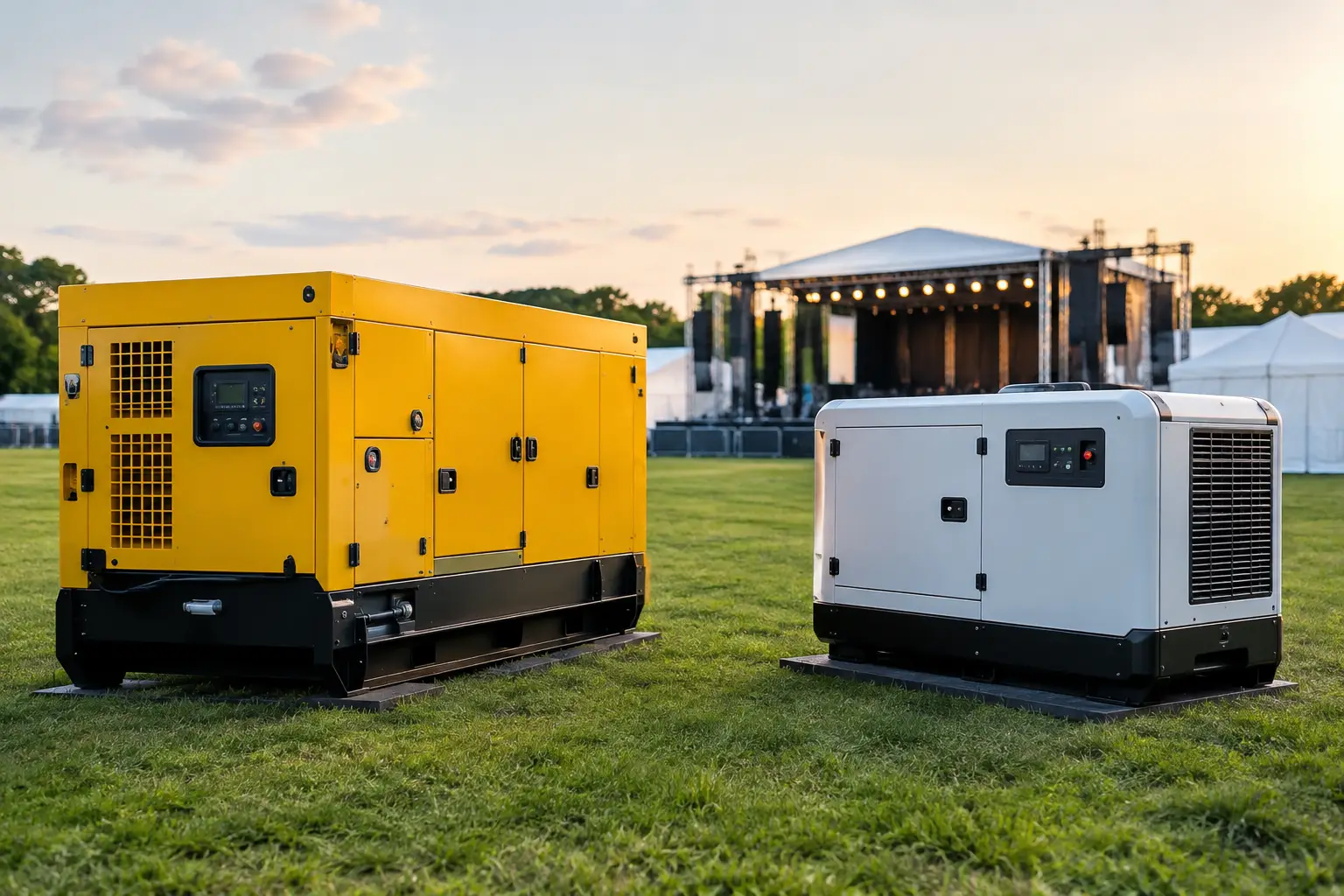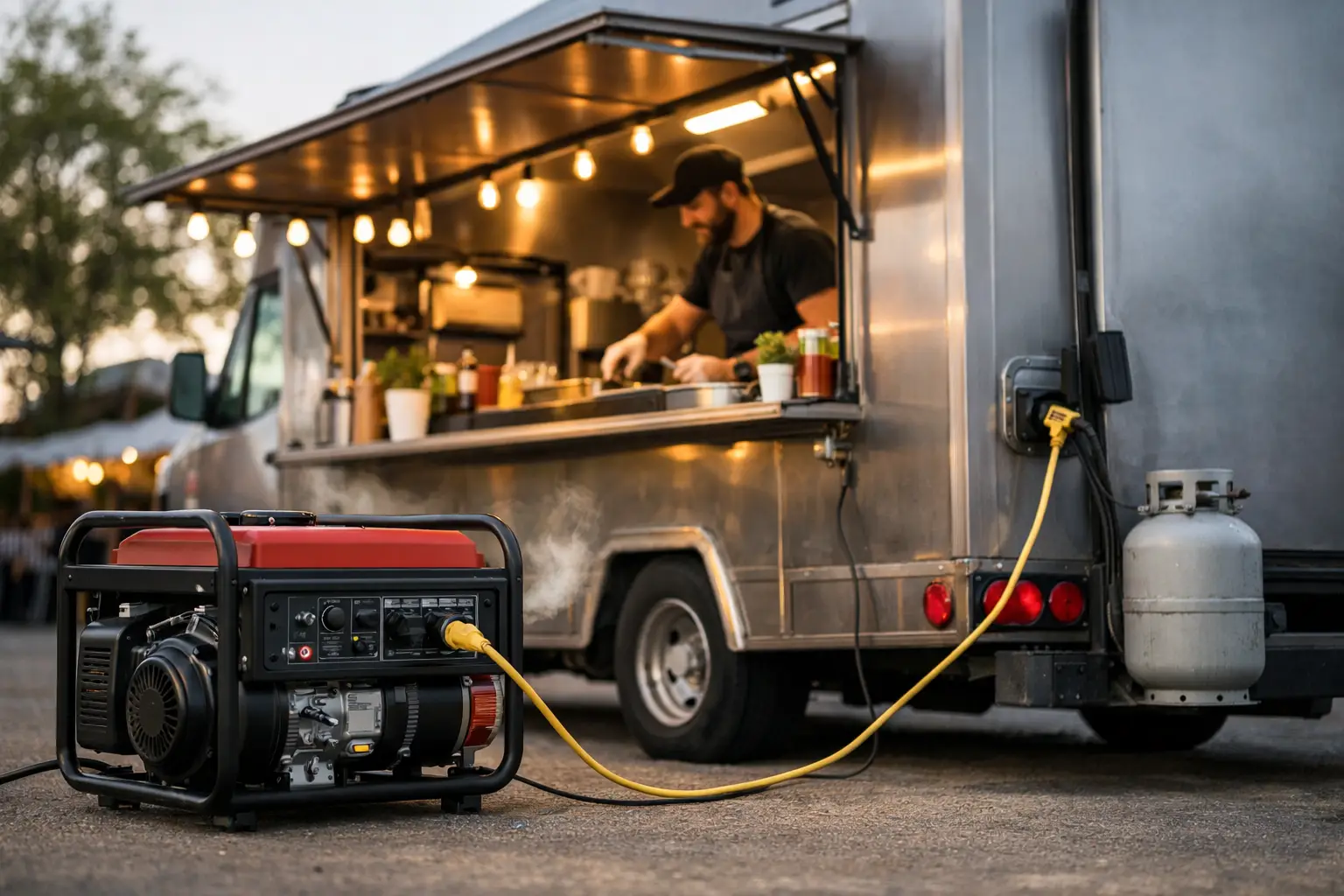
A food truck can look fully self-contained right up until lunch service starts. Then the espresso machine is running, fryers are recovering temperature, refrigeration cycles on and the EFTPOS terminal cannot drop out. So, can generators power food trucks? Absolutely – but only when the generator, distribution and site setup are designed around the truck’s real operating load, not a guess made from its plug size.
For an event organiser, food-truck power is not a minor site detail. A power failure stops trade, creates queues, risks spoiled stock and puts vendors under pressure at the exact moment guests expect fast service. Reliable power needs to be scoped before trucks roll through the gate.
Can generators power food trucks at an event?
Yes. Generators are routinely used to power food trucks at festivals, corporate functions, sporting events, weddings and public activations. The question is not whether a generator can run a mobile kitchen. It is whether it can handle the kitchen’s starting current, fluctuating demand and full-service peak while leaving enough capacity for safe, stable operation.
A coffee cart with a small machine and under-bench fridge is a very different load from a burger truck running twin fryers, grills, exhaust fans, freezers and a point-of-sale system. Some vehicles have a single-phase 10A or 15A inlet. Others require 32A or 40A single-phase supply, and larger units may need three-phase power. The plug tells part of the story, but it does not confirm the actual demand.
A properly planned generator setup also considers what else is sharing the supply. If the same generator is expected to run catering, a stage, lighting towers, site offices and public-address equipment, each circuit must be calculated and managed. Loading everything onto one convenient outlet is how a busy service period becomes an avoidable outage.
Start with the food truck’s real load
The most useful information comes from the vendor, not an assumption. Ask for the truck’s electrical schedule, inlet type, voltage, phase requirement, maximum demand and a list of major appliances. If that information is unavailable, a competent power provider can inspect the setup and establish a practical load plan before event day.
Food trucks often contain equipment with high heat demand or substantial motor starting loads. Fryers, hot plates, combi ovens, pie warmers and bain-maries draw sustained power while heating. Fridges, freezers, cool rooms, extraction fans and air-conditioning units can pull a higher current as compressors or motors start. Coffee machines add a sharp load during heating and recovery, particularly when several coffees are being made back to back.
The total on a nameplate is not always the total used every second, but neither is it safe to select a generator based on average consumption. Event power must account for coincident loads: the appliances likely to operate at the same time during the busiest 20 minutes of trade.
Why generator headroom matters
A generator operating near its limit may struggle when a compressor starts or when several heating elements switch on together. That can cause voltage drop, nuisance tripping, unstable appliance performance or a complete loss of supply. Electronics such as EFTPOS systems, POS screens and refrigeration controls are particularly unforgiving when power quality is poor.
As a working rule, the generator should have meaningful headroom above the calculated maximum demand. The correct allowance depends on appliance types, starting currents, whether the load is single or three-phase, and the generator’s duty rating. This is why generator sizing is a technical calculation, not a matter of hiring the next size up and hoping for the best.
Oversizing also has trade-offs. An excessively large generator can be inefficient at very low loads, use more fuel than necessary and increase cost and site footprint. The target is not the biggest unit available. It is a properly loaded unit with enough reserve to carry peak service without drama.
Single-phase, three-phase and balanced distribution
Many smaller food trucks run on single-phase 240V supply. These setups can be straightforward when every appliance is on one correctly rated circuit and the cable run is sensible. However, multiple single-phase trucks on a larger event generator still need careful circuit allocation.
Three-phase supply introduces another layer of control. A three-phase food truck may require a dedicated outlet and correctly configured distribution board. Where several single-phase vendors share a three-phase generator, loads should be balanced across phases. An unbalanced system can overload one phase even when the total generator capacity appears adequate on paper.
The distribution board is the control point between the generator and the food precinct. It should provide correctly rated outlets, circuit protection, residual current device protection where required, weather-resistant connections and clear separation between vendors. It also makes troubleshooting faster. If one truck develops a fault, the crew can isolate that circuit without blacking out every trader in the precinct.
The site setup is as important as the generator
A generator that is technically large enough can still create problems if it is positioned poorly or connected with unsuitable cabling. Food trucks need access for service, but the power plant needs controlled access, ventilation and space for safe refuelling. It cannot sit where exhaust affects guests, staff or food-preparation areas.
Cable routes need to be planned around pedestrian flow, vehicle movements, wet weather and emergency access. Leads crossing public areas require suitable cable protection. Cables should be rated for the load and distance involved, kept out of standing water and protected from damage. Long undersized cable runs can contribute to voltage drop, even with a correctly sized generator at the source.
Noise is another real-world factor. A generator beside an intimate wedding dining area or acoustic performance can undermine the event experience, while a generator placed too far away may create cable-management challenges. Good event planning weighs acoustics, access, exhaust direction, cable distance and visual presentation together.
Do not overlook fuel, backup and support
Food service can run for many hours, often across the point where generator fuel planning is forgotten. Fuel use depends on generator size and actual load, so run time should be calculated for the event duration, including setup, service and pack-down. A refuelling plan must allow for safe timing and access without interrupting trade.
For major events, contingency is part of the power design. That may mean spare capacity in the generator, separate supplies for critical vendors, a backup generator on site or a technician who can respond immediately if an issue develops. The appropriate level depends on the consequences of downtime. A single dessert cart at a small private function has different risk exposure from a food precinct serving thousands.
This is where dry hire can become a false economy. The generator arriving on a trailer is only one part of the job. Someone still needs to confirm loads, install compliant distribution, manage cables, monitor operation and solve faults under pressure. Zero Three Event Hire approaches event power as an operating system, with equipment and crew working to the same site plan.
A practical food-truck power brief
Before requesting a quote, gather the event date, site address, access times, vendor list and operating hours. For each food truck, obtain its inlet type, phase requirement and maximum demand, plus details of any high-load appliances such as coffee machines, fryers, ovens or air-conditioning.
Also identify whether the trucks need power during bump-in, overnight refrigeration or only trading hours. A vendor who needs refrigeration running from the afternoon before an event requires a different plan from one connecting just before gates open. If the site has existing mains power, it should be assessed rather than assumed suitable. Venue outlets are often limited, shared or unavailable at the location where the trucks must park.
Provide the site map early. It allows the power team to position generators, plan distribution, protect cable crossings and maintain clear paths for patrons, emergency services and deliveries. For public events in Melbourne, it also supports the documentation and coordination often required by venues, councils and event stakeholders.
A food precinct works best when its power is invisible. Traders serve quickly, refrigeration holds temperature, card payments keep moving and guests remember the food rather than the queue caused by a tripped breaker. Get the load data early, give the power plan enough headroom and put an accountable crew behind it – then let the event run until the last note drops.