A crowd will forgive a short queue at the bar. They will not forgive a headline act losing sound halfway through a set. This outdoor concert power planning example shows how a production team turns a site plan, artist rider and event schedule into a power system with enough capacity, clear separation and a genuine backup plan.
The goal is not simply to hire the biggest generator available. Oversizing without a distribution plan wastes budget; undersizing, overloading one phase or mixing vendors with critical production loads can stop the show. Good power planning gives every department a known connection point, protects the systems that cannot fail, and keeps the site safe from gates open until the last note drops.
What an outdoor concert power plan must achieve
Concert power has to do more than make equipment turn on. It must support changing loads across bump-in, soundcheck, performance and pack-down. A system that appears fine at 2 pm can fail at 8 pm when lighting is at full output, backline is live, catering begins service and a vendor plugs in an unapproved appliance.
A practical plan identifies the load, where it will be used, when it will be used and whether it is critical. It also records the cable route, distribution boards, phase allocation, generator location, fuel plan, emergency isolation and the people authorised to make changes. That detail is what prevents a last-minute coffee machine from sharing a circuit with front-of-house audio.
For public events, the design must also account for safe public access, weather exposure, traffic paths, noise, fumes and applicable electrical and event compliance requirements. The generator is only one part of the system. The distribution, protection, cable management and on-site crew determine whether the system performs under pressure.
Outdoor concert power planning example for 800 guests
Consider a one-day outdoor concert for 800 people. The site has a covered stage, front-of-house control position, LED screen, licensed bar, food vendors, backstage green room and site amenities. Gates open at 4 pm, the headline artist finishes at 10 pm, and pack-down runs into the night.
After reviewing production specifications and vendor requirements, the preliminary demand schedule could look like this:
| Area or system | Estimated operating load | Planning notes | |—|—:|—| | PA system, monitors and front-of-house audio | 18 kW | Critical during every performance | | Stage lighting and control | 26 kW | Allow for programmed peak use | | LED screen and video control | 7 kW | Kept separate from audio where possible | | Artist backline and stage utility power | 10 kW | Varies by act and changeover | | Production office, comms and charging | 4 kW | Includes control and operational equipment | | Food vendors and bar | 12 kW | Confirm each vendor appliance before site access | | Toilets, entry, work lights and miscellaneous site services | 3 kW | Include egress lighting for pack-down |
The estimated operating demand is 80 kW. That is not a cue to select an 80 kW generator and call it done. Generator ratings are normally expressed in kVA, and usable capacity is affected by power factor, motor starting current, non-linear loads, heat, altitude and how evenly the load is balanced across phases.
Why the nameplate total is not the generator size
In this example, a 150 kVA three-phase generator can provide approximately 120 kW at a 0.8 power factor. It gives the production system room to operate at a sensible load level rather than continually working at its limit. It also provides capacity for genuine peaks and for equipment details that emerge after the first technical brief.
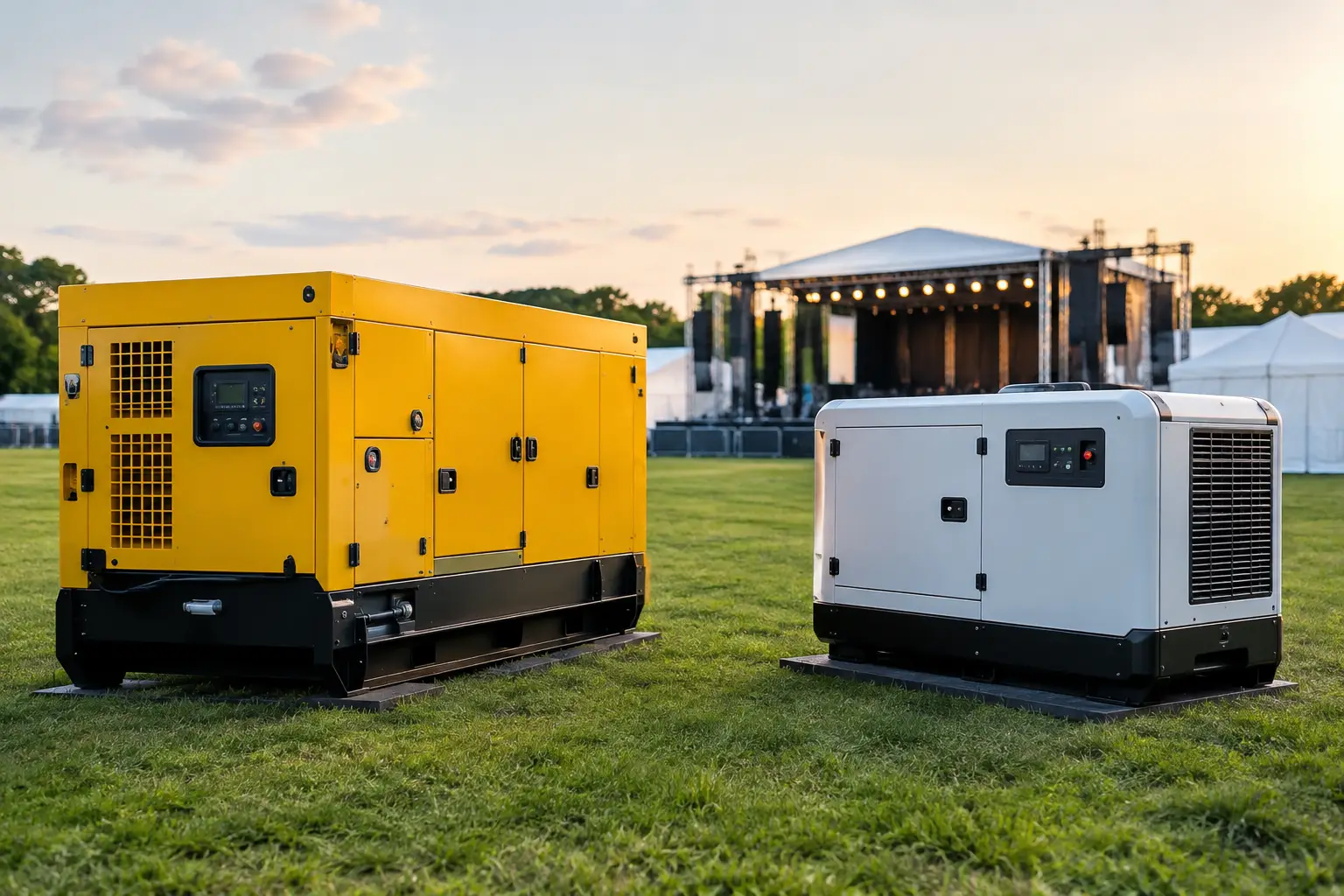
Rather than running the entire event from one source, the stronger approach is to separate production from public-facing services. The 150 kVA production generator can supply the stage, audio, lighting, video, backline and production control through managed distribution. A separate 40 kVA or 60 kVA generator can support vendors, bar refrigeration, site amenities and general services, subject to their confirmed load schedule.
This separation matters. If a food vendor has a faulty appliance or exceeds its agreed allocation, it should not take down the PA. It also makes fault-finding faster and prevents power-quality issues from travelling through the whole event.
For critical show systems, this plan should include a defined contingency. Depending on the budget and risk profile, that may mean a dedicated standby generator feeding selected essential circuits through a correctly specified changeover arrangement, UPS protection for control systems, or both. The audio console, network, communications, egress lighting and emergency operational systems should be considered separately from less critical loads such as decorative lighting or vendor refrigeration.
Build the power topology before equipment arrives
A power plan should be drawn around the event footprint, not assembled from loose cables on show day. Place generators in a ventilated, secured area that is accessible for delivery and refuelling but outside public circulation. Keep exhaust, noise and fuel management in mind from the first site walk, especially at suburban Melbourne venues where nearby residents and tight access can shape the whole design.
From there, map the feeder route to each distribution board. Stage distribution should serve stage-left, stage-right, lighting and backline circuits. Front-of-house needs its own appropriately rated supply for audio, lighting and video control. Vendor distribution belongs in its own zone, with metered or allocated outlets where the event requires tighter control.
Cable routes need physical protection wherever they cross vehicle lanes, pedestrian paths or public areas. Cable ramps, barriers, signage and planned crossing points are not presentation extras. They reduce trip hazards, protect insulation and stop a ute or forklift from damaging a feeder midway through the show.
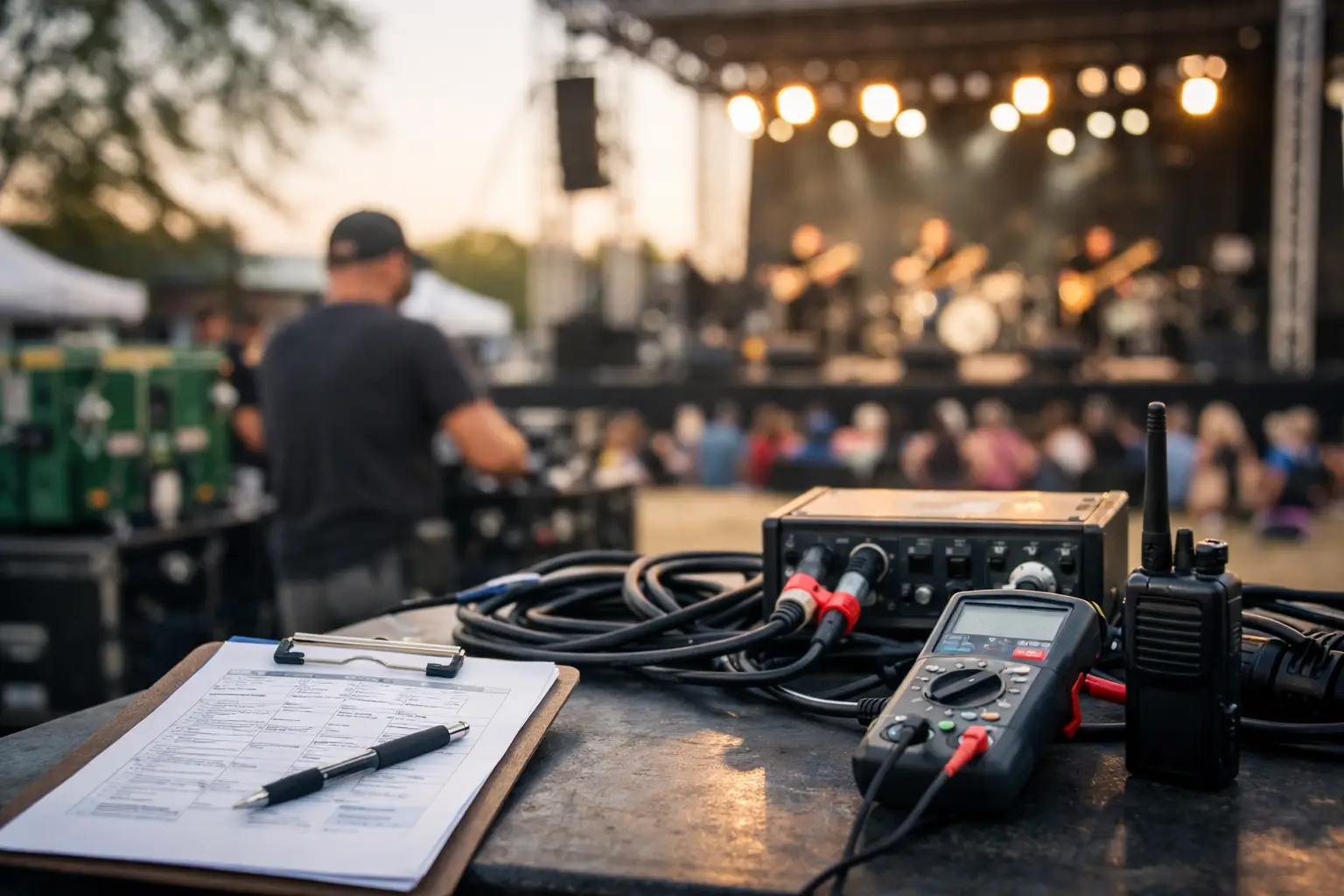
Phase balancing also needs active attention. A three-phase generator can have adequate total capacity while one phase is overloaded. Every major circuit should be assigned deliberately, then checked under load during commissioning. Qualified technicians should test protection, verify polarity and earth arrangements, label outlets and confirm that emergency isolation points are known to the crew.
Plan for time, fuel and changing conditions
The published performance schedule is not the generator runtime. Bump-in may begin at 7 am, with power needed for tools, stage construction and AV installation. Soundcheck can run for hours. Then the site needs work lights, security, refrigeration and pack-down power well after the audience has gone home.
Calculate fuel for the full operational window, including contingency. Generator fuel burn changes with load, so a generic runtime estimate is not enough. The plan should nominate who monitors fuel, when refuelling can occur, how the area is controlled during refuelling, and whether a standby unit or additional fuel storage is required.
Weather also changes the equation. Rain affects cable protection and work practices; heat can affect generator performance; wind can alter where exhaust and noise travel. If the site is exposed, generator placement and weather protection need to be resolved before trucks arrive, not improvised during a storm warning.
Put one team in charge of the critical decisions
A reliable system has a named power lead who owns the load schedule, distribution plan and change process. Artists, caterers, sponsors and site contractors should know that additional electrical equipment cannot be connected without approval. That is not red tape. It is how the crew protects capacity, phase balance and public safety.
Before gates open, the power lead should walk the site with production, security and venue representatives. Confirm generator access, cable routes, isolation points, fire equipment, noise controls, fuel status and contacts for every department. During the event, monitor actual load and respond before a minor issue becomes a show interruption.
Zero Three Event Hire approaches this as a managed production scope, not a generator drop-off. That means power can be planned alongside staging, audio, lighting, structures, access and on-site technical support, with accountability sitting in one place when conditions change.
What to provide when requesting an event power quote
A useful brief includes the site plan, event dates and operating hours, expected attendance, stage and front-of-house locations, artist technical riders, lighting and video requirements, vendor list, amenities, access restrictions and any venue rules. If the load is unknown, say so early. An experienced production team can identify the missing information before it becomes an expensive site-day variation.
The most useful quote will separate generators, distribution, cabling, fuel, delivery, crew, standby provisions and compliance documentation. Clear itemisation makes it easier to decide where redundancy is essential and where a simpler solution is appropriate.
Power should feel invisible to the audience. Getting it there takes a load schedule, a controlled site, tested distribution and a crew prepared for the moment the plan meets real life. Build that discipline into the brief, and the only thing the crowd notices is the show.